Real-World Applications of Federated Learning
Federated Learning in Action: Impact Across Industries
Federated Learning in Action: Impact Across Industries
Federated Learning (FL) is not just a theoretical concept; it's a powerful paradigm actively being implemented across diverse industries to solve complex problems while championing data privacy. By enabling collaborative model training without data centralization, FL is unlocking new possibilities for AI innovation in sensitive domains.
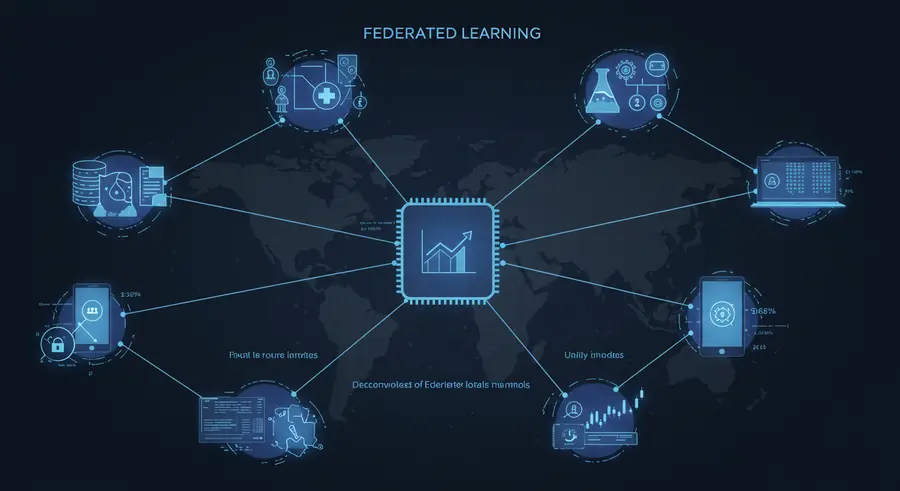
The Power of Decentralization: FL allows organizations and devices to collectively build smarter AI models from their local data, ensuring that sensitive information never leaves its original location. This collaborative intelligence is transforming how we approach data-driven solutions.
Healthcare: Revolutionizing Medical AI with Privacy
One of the most critical sectors benefiting from Federated Learning is healthcare. Medical data is inherently sensitive, making traditional centralized machine learning approaches challenging due to privacy regulations and data silos. FL offers a solution:
- Disease Diagnosis and Prediction: Hospitals can collaboratively train models for more accurate disease diagnosis (e.g., identifying rare diseases from distributed patient data, improving tumor detection in medical images) without sharing individual patient records.
- Drug Discovery and Personalized Medicine: Pharmaceutical companies and research institutions can leverage distributed datasets to accelerate drug discovery or tailor treatment plans based on aggregated insights from diverse patient populations, all while maintaining patient confidentiality.
- Epidemiological Studies: Analyzing health trends and outbreak predictions across different regions without direct data exchange.
Finance: Enhancing Security and Insights
In the financial sector, federated learning is transforming how institutions manage risk and detect fraud. By analyzing distributed transaction data without centralizing sensitive information, banks can build more robust fraud detection models. This approach also extends to areas like credit scoring and market trend analysis, offering enhanced AI-driven portfolio management while upholding strict data privacy. The ability to collectively learn from diverse datasets without ever exposing individual data points represents a significant leap forward in secure financial AI.
Mobile Devices: Smarter On-Device AI
Federated Learning was pioneered in the mobile space, addressing the challenge of training AI models on vast amounts of user data residing on smartphones and other personal devices. This has led to significant improvements in:
- Predictive Keyboards: Learning user typing patterns and vocabulary without sending private conversations to the cloud.
- Voice Assistants: Improving speech recognition and understanding by training on diverse user accents and commands locally.
- Personalized Recommendations: Delivering tailored content suggestions for apps, news, or media based on on-device usage patterns, enhancing user experience while preserving privacy.
Internet of Things (IoT): Intelligence at the Edge
The proliferation of IoT devices generates immense amounts of data at the edge of the network. Federated Learning is perfectly suited for this environment:
- Smart Homes and Wearables: Improving device responsiveness and personalization by learning from local sensor data (e.g., energy consumption patterns, activity tracking) without centralizing sensitive personal habits.
- Industrial IoT: Enhancing predictive maintenance for machinery by training models on sensor data from factories, preventing costly downtime and optimizing operations across multiple plants.
- Autonomous Vehicles: Collaboratively learning from driving data across a fleet of vehicles to improve navigation, obstacle detection, and safety features, all while ensuring individual vehicle data privacy.
Beyond the Mainstream: Other Emerging Applications
The versatility of Federated Learning extends to many other domains:
- Manufacturing and Supply Chain: Optimizing production lines and logistics by learning from distributed operational data.
- Smart Cities: Enhancing traffic management, public safety, and resource allocation by analyzing localized urban data.
- Cybersecurity: Developing more robust threat detection systems by collaboratively learning from diverse network traffic patterns and attack signatures without centralizing sensitive security logs.
Conclusion: The Future is Federated
Federated Learning is fundamentally changing the landscape of AI development, proving that powerful artificial intelligence can coexist with stringent data privacy. As data continues to grow and privacy regulations become more robust, FL will increasingly become the go-to approach for developing intelligent systems that respect individual and organizational data boundaries. Its ability to enable collective intelligence from distributed sources makes it a cornerstone technology for the next generation of secure and ethical AI.